Prefabricated homes are hugely popular in Germany, Australia and the United States. However, they’ve only managed to corner a relatively small part of the UK housing market.
This is a shame because prefab houses offer big developers speedy construction, cost certainty and economies of scale. The government has clocked this and has been pushing for greater uptake in a bid to help solve the housing crisis.
But the fact is, the main group investing in prefab homes has been (you guessed it) self builders. And some of us don’t even realise we’ve technically gone prefab.
What is a prefab home?
If the idea of a prefab house fills you with dread, fear not. Times have moved on since the cheap and cheerful boxes that pervaded the mid-20th century.
Speed of delivery is still important. But modern offsite-manufactured homes are now about design flexibility, accuracy and quality control.
One thing that’s worth clarifying early on is that prefab is a broad church covering a range of options. It doesn’t necessarily mean craning in entire pre-finished rooms.
In fact, by far the most common route for self build projects is to engage a company that specialises in highly pre-manufactured closed panel timber frame.
Source it: Find more Hanse Haus projects in the Build It Directory
This is the type of product that’s come to our shores via the German package home suppliers, such as Baufritz, Hanse Haus and Meisterstueck. It’s something of a hybrid route, where much of the internal fit-out work is still carried out onsite.
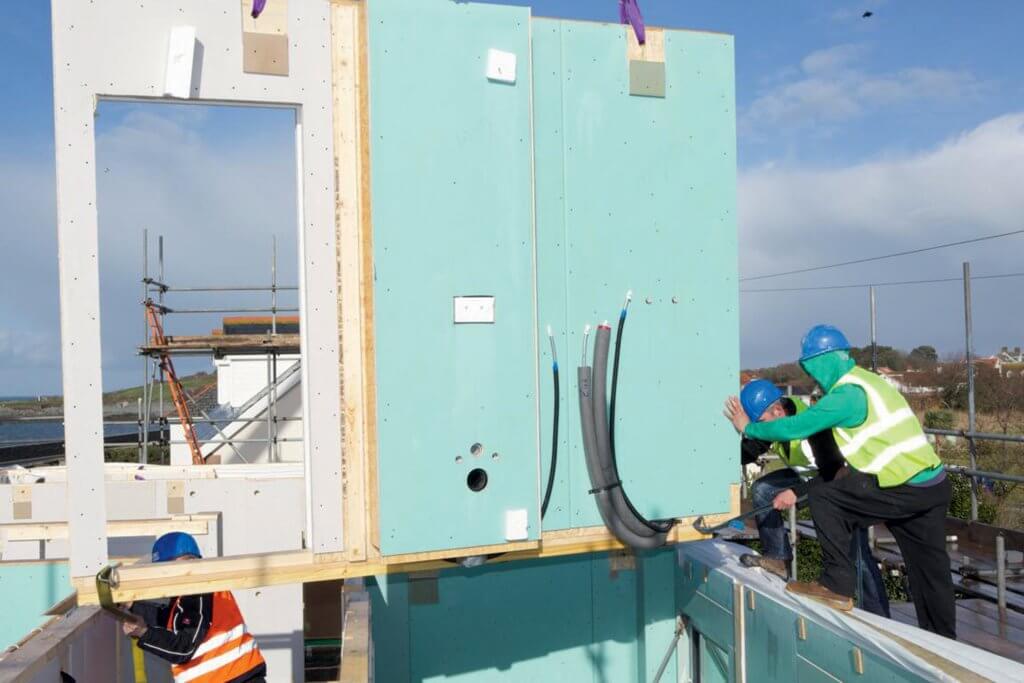
Site operatives install a Hanse Haus internal wall panel, which has been manufactured with service channels and some plumbing infrastructure in place
With this kind of structural system, the company produce the wall and roof panels in the factory. They pre-cut the door and window openings and add insulation under controlled conditions.
All fairly basic stuff so far – but what sets the prefab versions apart is that a lot more of the work is done offsite.
“Our external wall panels will be fitted with doors, windows and ideally the cladding. Or at least as much of it as you can possibly put on in the factory,” says Robert Lumme from Baufritz.
Some suppliers can take things a stage further, with plasterboard pre-applied internally and sections of the services already run through the channels. This will save even more time on the ground; but Robert warns that going too far can be restrictive.
“We may pre-drill a few holes for sockets that we’re certain will be in a particular position. But we prefer to put the electrics, plumbing and heating in onsite. This is for the simple reason that people like to amend things once they see the house shell in reality,” he says.
The next step up is a fully prefab build – also called modular or volumetric constructions.

Large-scale wall panels are produced with speed and accuracy in the Baufritz factory
With this route you’re dealing with large, 3D building elements that could represent whole rooms or sections of building; sometimes with the services, internal fit-out and finishes already installed and commissioned. In some cases, companies can deliver entire homes in a matter of weeks.
The modular method is pretty rare for one-off houses as the level of factory manufacture makes for a high upfront cost; but it could make sense for some custom build or community self build schemes.
Interestingly, in terms of domestic projects modular construction is currently more frequent for extensions. This is perhaps because the ability to crane in an entire single-storey room or habitable loft pod can be useful in certain circumstances – such as where there’s tight access to terraces.
There are a number of firms specialising in this area, including Ecoqube and Moduloft.
Is prefab right for me?
If you’re looking for a high-quality bespoke scheme, then it could be the best option. But every project and every self builder is different.
Here are five key questions to consider when figuring out how to approach your project:
1. Can you have an individual design?
It’s a common myth that extensive levels of factory manufacture lead to more standardised architecture; in fact you can tailor your home to your exact needs, both in terms of aesthetics and how it suits your lifestyle. Many firms put a real focus on high-quality design and construction; and a number of architects, including the likes of Ecospace, have moved into the arena.
Small Prefab Home Clad in Charred Larch
|
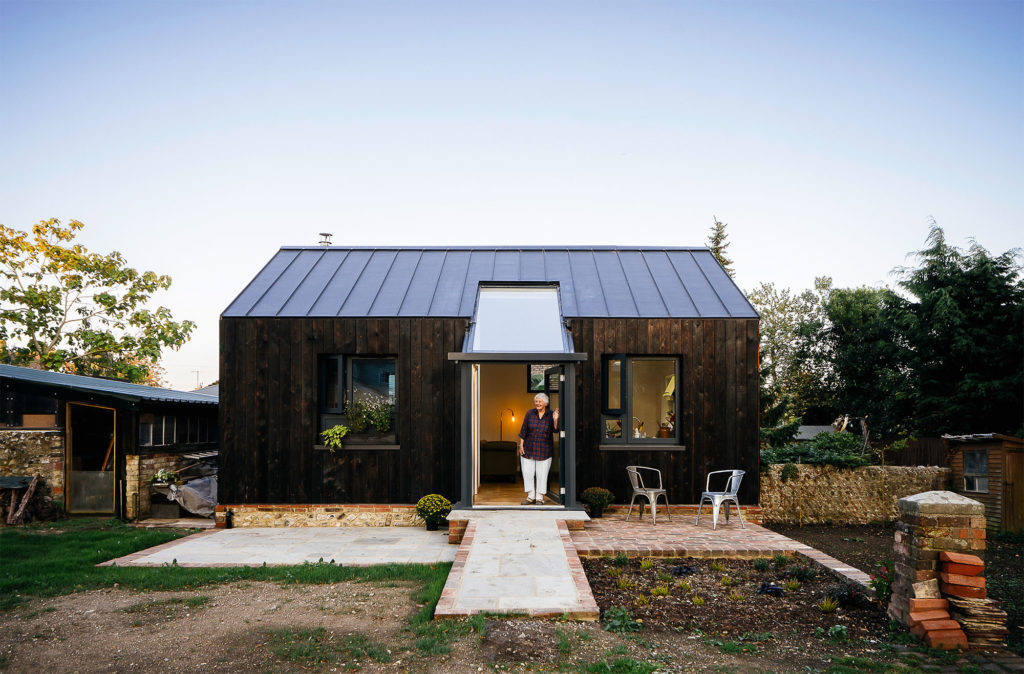
The key difference to the traditional route is that you need to think through all the details prior to manufacture. But you still get all the design control you would expect with a bespoke project.
“There is a lot of pre-planning, because the panels have to be drawn up in detail. They have to be made to exact millimetre-precise dimensions,” says Robert. “But we’re able to quite flexibly create very different shapes, sizes and styles of building.”
If you’re going all-out for a modular scheme, changing things on site is likely to be difficult. There’s slightly more flexibility with the closed-panel route; but it won’t come cheap. For instance, if you want to make a window bigger you’ll need to involve a structural engineer.
2. Do prefab homes last?
It’s a simple fact: the more work gets done in the factory, the more accurate the finished house will be. This can help underpin key areas for self builders, such as energy performance.
The post The Benefits of Prefab Homes appeared first on Build It.
Article reference The Benefits of Prefab Homes

No comments:
Post a Comment