Once you’ve got your roof tiles on, it feels like the hard work is over with this section of your build – but there are plenty of decisions to come.Some, such as the type and specification of guttering, are pretty obvious (although bear in mind that your architect’s drawings are not the same as a fully realised drainage plan). Others – the exact detail of how to box in the ends of a gable roof, for instance – probably need to be worked out on site.
We want to get these elements right to complement the fantastic look of the Dreadnought roof tiles. So we’ve partnered with Rainclear Systems, a leading UK supplier of metal rainwater and drainage solutions, for this part of our project.
They provided just the kind of customer service we were looking for, steering us towards good quality solutions and working with us to ensure we ordered the right products in the right quantities.
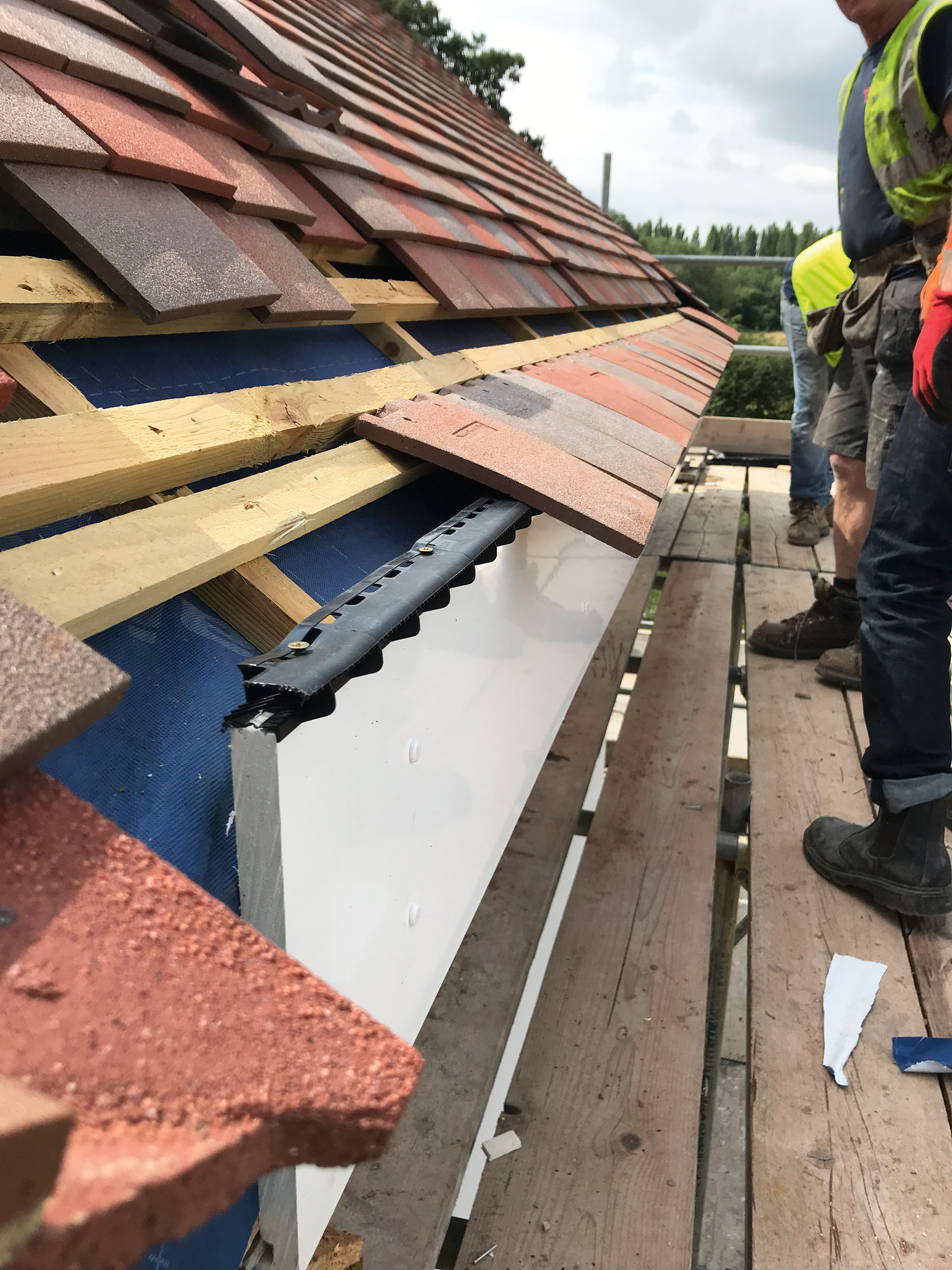
Peter from Thames Valley Guttering Services prefers to fit the ventilation at the fascia, rather than the soffit, so it’s more hidden and you get a really clean finish when you look up at the roof from ground level.
Peter McKibbin from Thames Valley Guttering Services is taking care of the installation (including sourcing and fitting the roofline products).
Getting the roofline right
They may not be the most glamorous part of a finished home, but the soffits, fascias and bargeboards fitted to the outer edges of your roof play an important role in protecting it from damage. Combined with the adjoining wall claddings, these elements are collectively known as the roofline.
Fascias are fixed vertically at the eaves of a roof to close the gaps between the rafters, while soffits horizontally below to hide the underside of the roof structure. Behind the fascia is usually a timber fascia board to provide a fixing point for rainwater goods.
The bargeboard is the finishing section at gable ends – and, as it doesn’t get covered over with the guttering, it can make or break the finished look of a house.
These components act as a physical weatherproofing barrier and enable ventilation – ensuring any moisture that does get past the first line of defence is evaporated off. They also provide a handy guide for where your render and other external finishes need to come to. So you could think of them as decorative trims with a practical purpose.
The post Roofline and Rainwater Goods appeared first on Build It.
Article reference Roofline and Rainwater Goods

No comments:
Post a Comment