Larry Nixon had been looking for a plot for a few months when a friend of his pointed out a piece of unused land on a town-edge housing estate.
Having taken a look at it, Larry thinks it would be ideal for the type of traditional, four-bedroom family abode that he’d like to build. Could this site offer the potential he’s looking for?
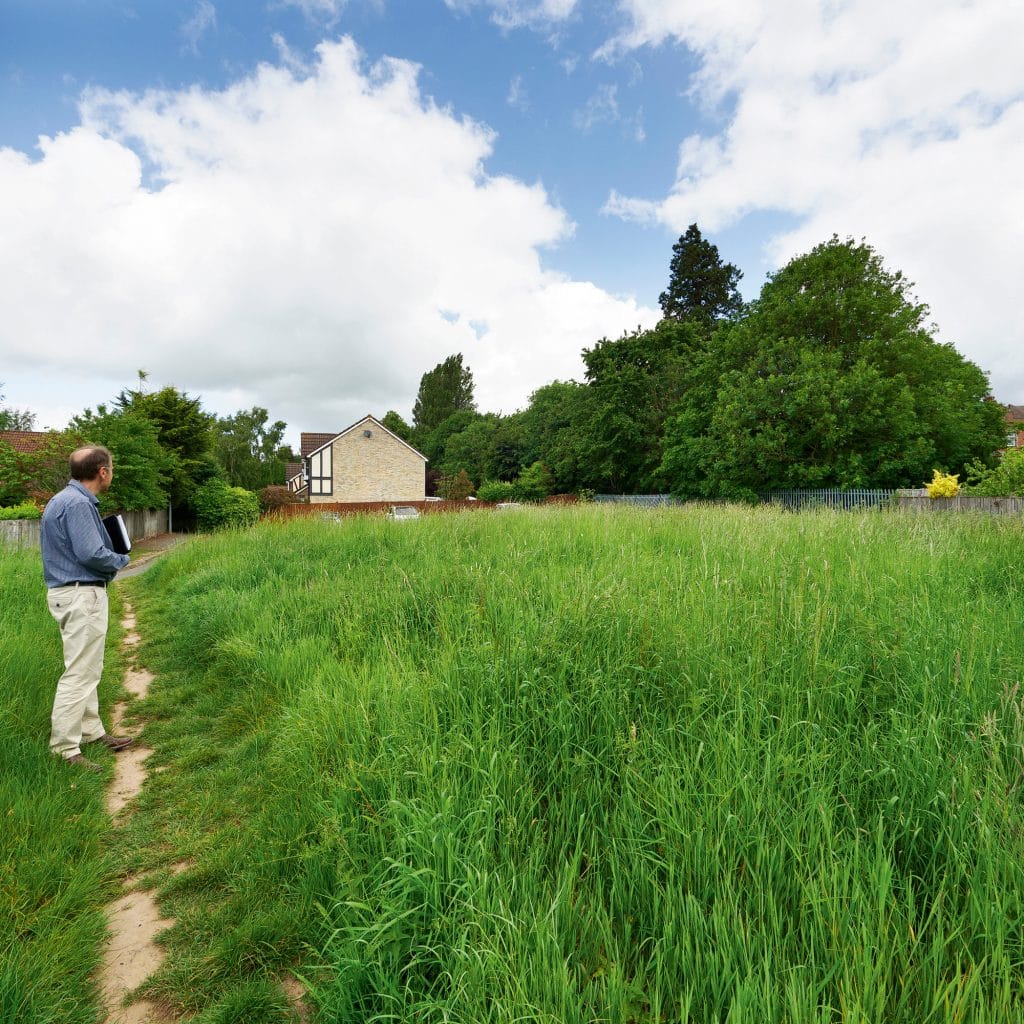
The plot is mainly rough grass, about 35m deep by 20m wide, with a very slight slope down from back to front. An access road to the car park – and the car park itself – are on the west side, with detached houses on the east.
At the rear is a school playing field, with trees running along the site boundary. Towards the frontage is a single poplar tree, but otherwise the land appears free from any obstacles to building.
It’s clear that a detached home would sit comfortably here, with an open southerly aspect to the front of the site.
Ownership
With a potential plot on an estate like this, it can be difficult to pin down who owns it. Larger estates are often worked on by several developers. Some areas of land adjacent to the roads may be within the ownership of the highway authority, and other open spaces may have been taken over by the district or parish council.
Normally planning records are an easy starting point for finding owners, but not here, as it’s highly likely this has changed since the original planning permission was granted for the estate. Larry will need to do a map search via the Land Registry website. This should hopefully unearth the proprietor, as there’s a reasonable likelihood of the ownership being registered, given that the estate was constructed in the 1980s.
Planning principle
Getting planning permission for a dwelling on an estate sounds like it ought to be straightforward. It is in that the principle of housing isn’t in question, as is often the case in more rural situations. That said, these developments are built to a particular design, and open spaces are often as much a part of that scheme as the homes themselves.
Whilst that’s true as a generalisation, there are many instances of infilling and additional properties being permitted on estates across the UK. Here, the plot is something of an oddity, as is the car park adjacent to it. Neither seem to sit comfortably into the overall development.
There is a stub of road leading to the boundary with the adjacent playing fields. It’s possible the original estate layout was left a little open ended in this location to allow for the option of a new road extending the development into the playing fields. Another possibility is that the land and car park were used as some sort of depot during the construction phases.
Whatever the reason, it certainly looks now as if a new detached house could comfortably sit alongside its neighbour to the east. Both the car park and some additional land around could remain so as to continue to provide an open space.
Planning details
A new dwelling would need to work with the established pattern and the prevailing scale and designs of those in the vicinity. Most of the houses are detached or link-detached.
There’s also a wide range of styles, materials and finishes. That said, everything is fairly uniform, so going for something that fits in would be a much easier task than aiming for a contrasting scheme. As the new property would fall at the end of a row, it would need to sit more or less in line.
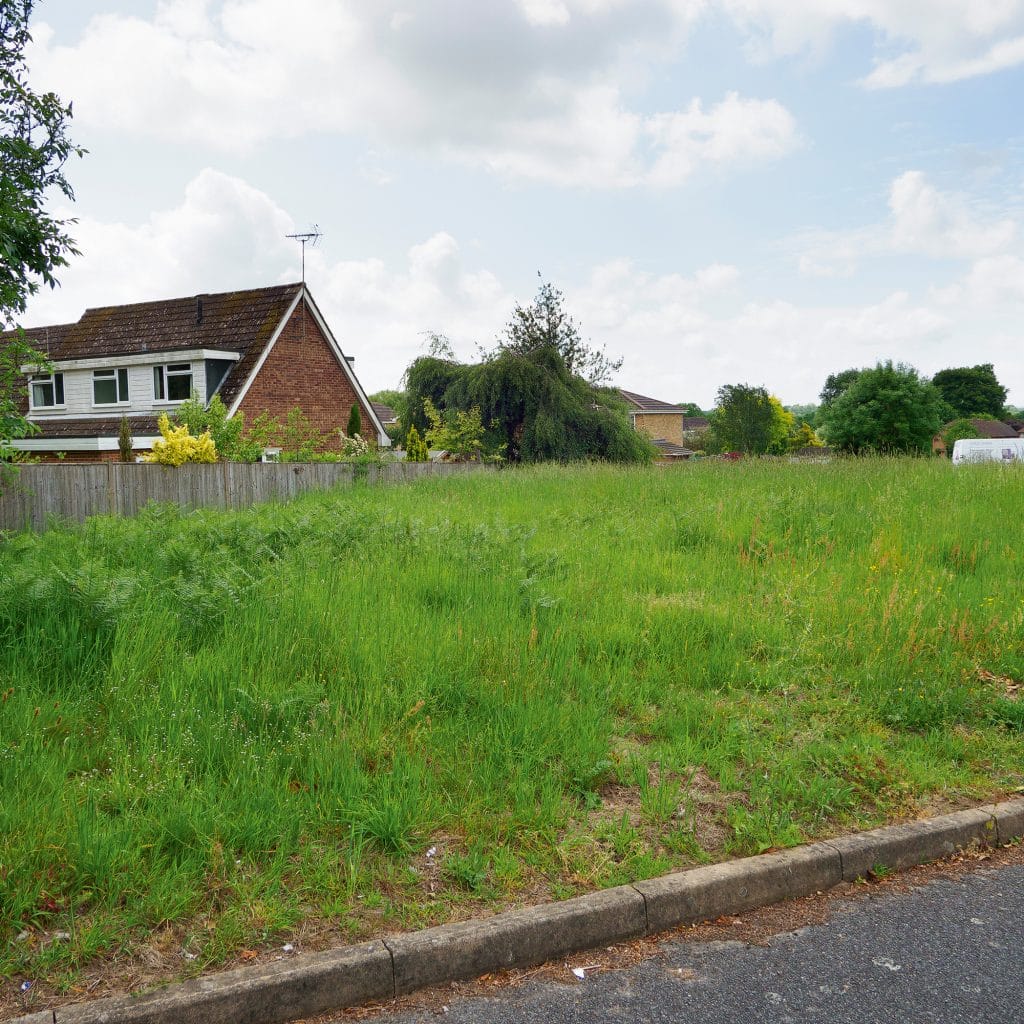
Luckily the flank elevation of the adjacent house, which is a chalet style, has no upper floor windows facing the plot, so there wouldn’t be any issues with privacy or loss of outlook. Access would be onto the estate road at the front of the site, and there’s also excellent visibility so no likely highway safety issues.
It would be reasonable to think that all mains services would be available, but Larry should have a good look over the plot in case there are any manholes that might suggest there are services running under it.
Given that Larry wants to construct a traditional style four-bedroom abode, there shouldn’t be any insurmountable issues with the design or layout. This one is all about whether building on this apparently leftover bit of land would be acceptable in principle.
Next steps
There are two routes for Larry to follow. The first involves establishing who owns the site and if they’d be willing to sell.
The second involves finding out from the council whether planning permission might be forthcoming. There’s something to be said for approaching the local authority first, as a thumbs up would enable a much more positive approach to the owners.
Larry could draw up some sketch plans and seek pre-application advice. You don’t need to own the land in question to do this, and although the cost and time it takes to get an answer varies from council to council, it shouldn’t be prohibitive.
The post Planning Expert Mike Dade Investigates a Sloped Plot appeared first on Build It.
Article reference Planning Expert Mike Dade Investigates a Sloped Plot

No comments:
Post a Comment